Response to Critics
Finance still matters for housing

AEI has issued a response to a recent Groundwork Collaborative paper Fixing Housing Means Fixing Finance: Why We Can’t Deregulate Our Way to Affordability, by J.W. Mason and me, as well as a paper by Paul Williams of the Center for Public Enterprise on similar themes. It’s the central claim of both papers – that finance is a significant bottleneck in housing production – that AEI takes issue with. As an author of one of the articles, I would like to offer a response to their response.
Though AEI does concede that financing conditions matter to housing development, they assert that local zoning rules, red tape bottlenecks, and approval risk matter “far more.” AEI’s critique of our paper rests on three points: national construction trends aren’t as sensitive to financing conditions as you’d expect, metro-level variations underscore local feasibility factors, and timeline data show that regulatory barriers rival financing costs. As the authors in their own words summarize their three claims:
First, recent national multifamily construction trends show adjustment to higher rates, not a collapse consistent with a binding national financing constraint. Second, metro-level construction patterns vary widely under the same interest-rate environment, suggesting that local feasibility conditions play an important role in determining where construction occurs. Third, evidence on development costs and timelines shows that in many high-cost or highly regulated markets, regulatory barriers, permitting delays, and land-use restrictions can affect project feasibility as much as, and sometimes more than, financing costs.
It should also be noted that AEI never actually contests our core argument – that the private sector can’t build to affordability – instead relying on a related but distinct argument about the private sector’s willingness and incentives to build at all.
I will address their first two critiques. The third is truly outside the scope of our original paper, and does not appear to be a true source of disagreement. As we (and the Center for Public Enterprise) explicitly stressed in our reports, we welcome efforts to liberalize zoning and streamline construction timelines.
Financial Conditions are More than Interest Rates
While AEI uses the pre- and post-pandemic interest rate periods to conclude that multifamily construction trends adjust to – rather than collapse with – higher rates, the sum total housing financing environment is made up of more than just interest rates.
The Federal Reserve system does fix short term US dollar funding rates globally via its monetary policy, and these funding rates filter through to long term borrowing rates facing households and firms. The real estate sector is, of course, subject to changes in monetary policy, and virtually all commercial real estate in the US is financed with US dollar denominated debt. However, financing conditions are not geographically identical. Even on the debt side, different markets or even submarkets experience distinct lending conditions for real estate loans.
But more importantly, financial conditions are not limited to interest rates on debt. They comprise the entire capital stack, including equity which demands a much higher rate of return than debt and which is not tightly linked to short term funding rates. As AEI’s authors correctly point out, expected rent growth is key to delivering these returns:
The relationship between the low-rate construction boom and the post-2022 adjustment also appears weak. Several markets that experienced especially large pandemic-era building booms, including Austin, Raleigh-Durham, Nashville, Phoenix, and Charlotte, experienced sharp subsequent declines in starts as rent growth softened and supply pipelines normalized. In some cases, starts fell by more than 50 percent from their 2022 peaks. These declines likely reflected not only higher financing costs, but also market-specific corrections after unusually rapid pandemic-era supply growth.
As we underscore in our Groundwork report, rent growth is key to attracting equity financing to actually get projects off the ground – even when interest rates are low.
In a similar vein, pandemic internal migration patterns caused rents to collapse in many large metros (like Los Angeles, Boston, and Chicago) and surge in others (like Austin, Phoenix, and Raleigh-Durham). Most of the 2020-2022 apartment boom happened in places with surging rents because, crucially, interest rates were not only low, but equity was willing to finance projects where rent growth meant juicy capital gains.
For example, collapsing rents in San Francisco crushed project economics – despite low interest rates. Of course, it is correct that San Francisco’s collapsing rents (which are now surging) in 2021 represented a market signal that more housing was not needed. Indeed, San Francisco has become substantially more affordable since 2017 because nominal rents are flat since then. However, many cities have seen significant rent increases since 2020 without the concurrent increase in housing production.
One explanation is that rent growth in those areas was not high enough to produce the needed rates of return to attract equity capital. Here, there is undoubtedly a difference in underlying philosophy. Right-leaning policymakers would assert that such conditions means that no intervention is needed, since investments which fail to clear hurdle rates are a misallocation of capital. Left-leaning policymakers may accept the misallocation of capital as a mechanism to some modest redistribution to lower income households via lower housing costs.
AEI shows two charts comparing housing production from 2015-2022 to that from 2022-2025 at the submarket level as “proof” that finance does not explain rates of housing production, but their analysis is limited to merely interest rates on debt. Their contention is that since changes in rates of production are not uniform even though interest rates rose dramatically in 2022, financial conditions are not a binding constraint on housing production.
But then the authors offer an explanation about why these charts should not be uniform! Financial conditions to build housing are not merely interest rates on debt, but demanded rates of return on equity, which of course vary market to market and could very plausibly explain the observed variation. In the words of the authors:
Multifamily financing conditions clearly tightened after 2022. CBRE’s North America Cap Rate Survey shows that Class A stabilized multifamily cap rates rose materially after the low-rate period, increasing the required yield for new projects and reducing take-out valuations. The reset was not uniform across metros: in the CBRE data, cap rates widened much more in some markets than others. That variation likely reflects more than interest rates alone. Cap rates also incorporate local rent-growth expectations, supply pipelines, perceived overbuilding risk, investor demand, and the ease or difficulty of adding new units. In several high-growth Sun Belt markets, cap rates appear to have compressed more during the low-rate boom and then widened more sharply after 2022, suggesting a market-specific pricing cycle layered on top of the national rate shock. The key point is that while financing conditions matter, they operate through local market conditions rather than independently of them.
Indeed, financial conditions such as compressing cap rates (and therefore higher exit valuations) greatly expanded the envelope of feasibility in cities in the sunbelt which saw huge apartment booms. Of course, cap rates did not compress because of upzoning or streamlining of permitting, it was because of surging rents mostly caused by pandemic migration.
All real estate is local. But by limiting themselves to only interest rates, and not other parts of the capital stack, AEI’s critique undermines its own evidence that financial conditions don’t sufficiently explain rates of housing production, as well as elides a key contribution of our paper.
The Strength of the Local Multifamily Market Explains the Recovery in Starts
AEI’s second critique of our paper is that financing cannot be the binding constraint on housing construction, if, as they claim, wide variability in construction patterns across metro areas means that local feasibility conditions play a more important role in determining where construction occurs.
In general, the uneven recovery in starts across markets is not evidence that financial conditions are unimportant. It is evidence that market level project economics are also crucial for the viability of new construction.
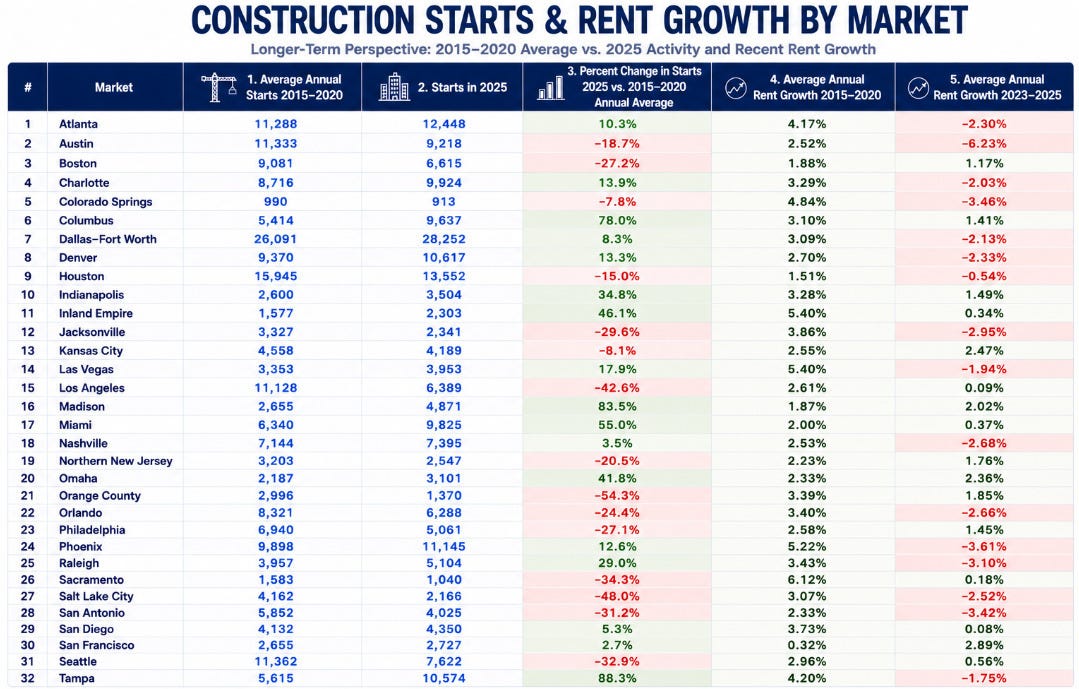
To demonstrate, we used CoStar data and AEI’s rather odd choices of dates, to show that roughly as many markets produced more housing in 2025 relative to the period of 2015 to 2020 as vice versa.
In the figure below, we include the years 2021 and 2022, banner years for apartment construction. Now, only a handful of markets produced more housing in 2025 relative to the 2015-22 average. This data makes it hard to accept the claim that financial conditions (including interest rates, cap rates, and project economics) do not explain the rate of housing production.
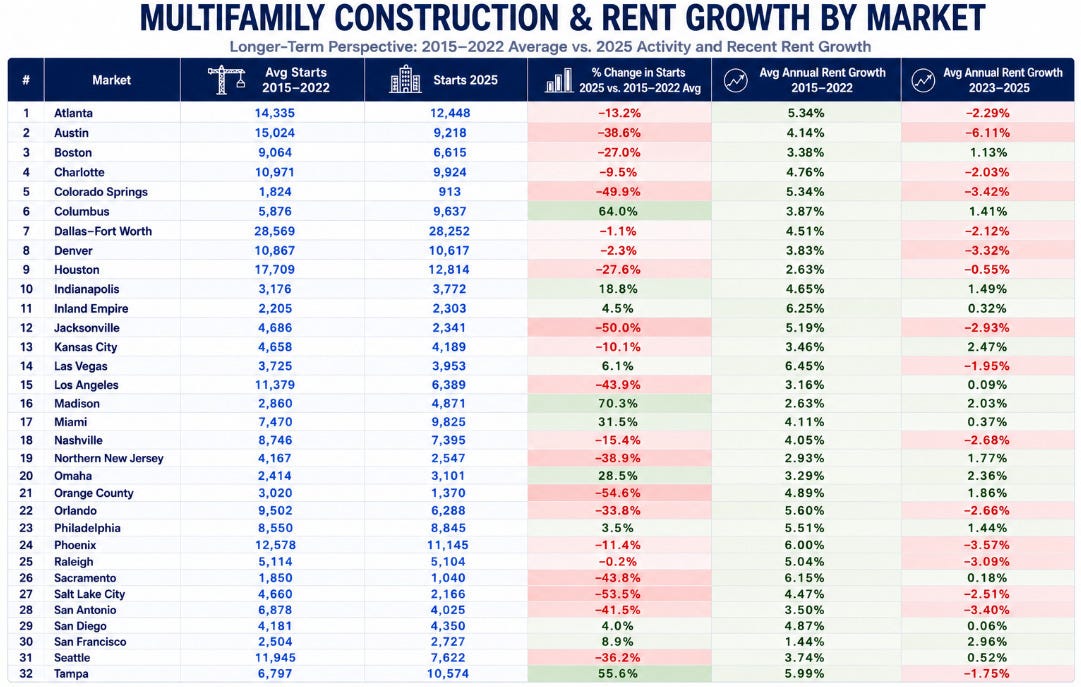
Though recoveries have been uneven across markets since the pandemic, an overall increase in the value of multifamily properties is tightly correlated with the recovery in starts. Since 2022, the value of multifamily assets have declined considerably, both due to the rise in interest rates and the deceleration of rent growth. Furthermore, multifamily valuations are a particularly good metric to gauge the strength of the market, since they capture both current rents/NOIs, but also investor expectations about rent growth in the future.
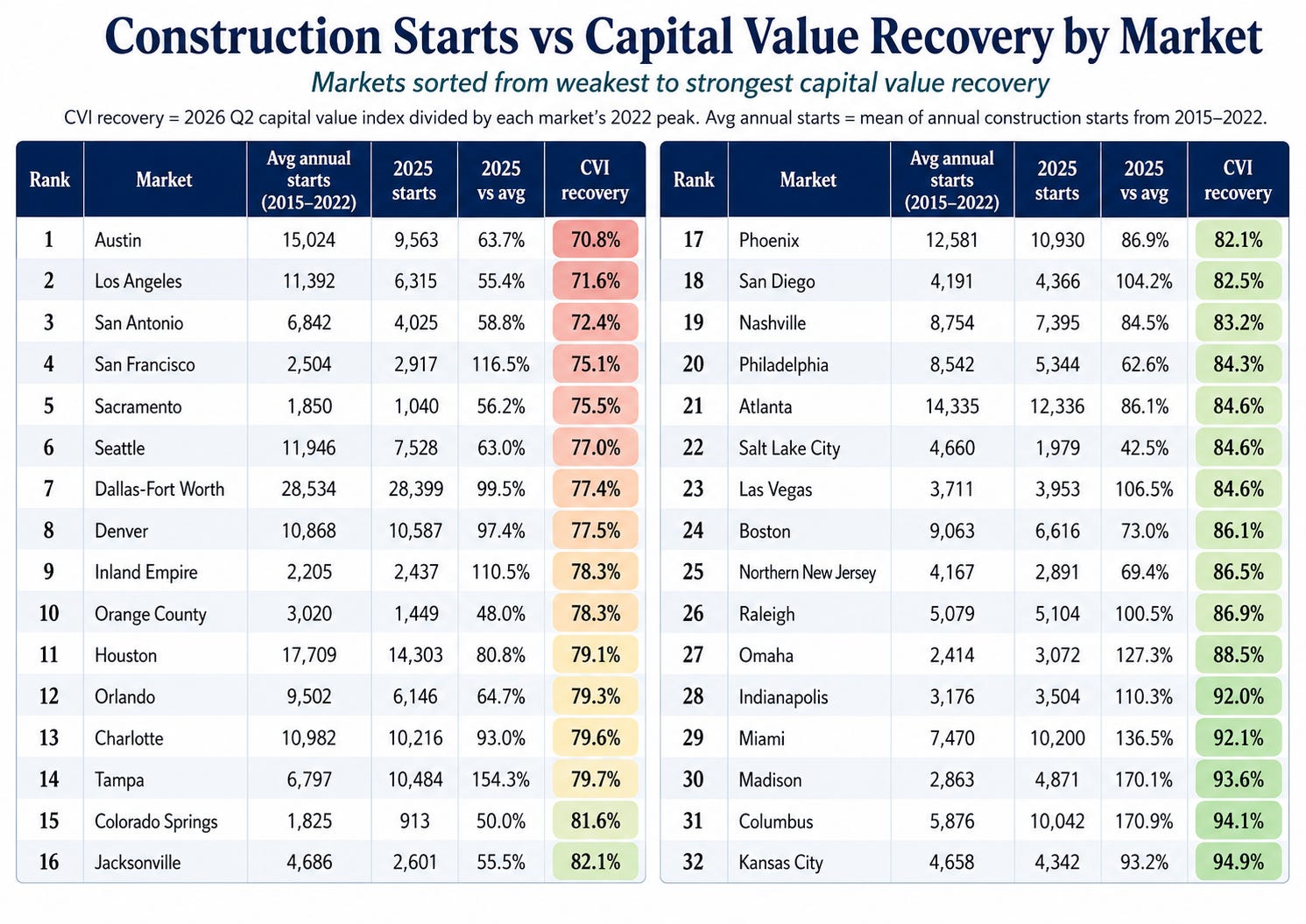
Here, we observe starts in 2025 versus average annual starts from 2015-2022. The final column is the 2026 value of multifamily assets as a percentage of the 2022 peak. While no market has fully recovered, markets such as Madison, Omaha, and Columbus have nearly fully regained their peak 2022 values. It is no surprise that these markets have also seen the strongest construction recoveries, and actually exceeded their 2015-2022 average in 2025.
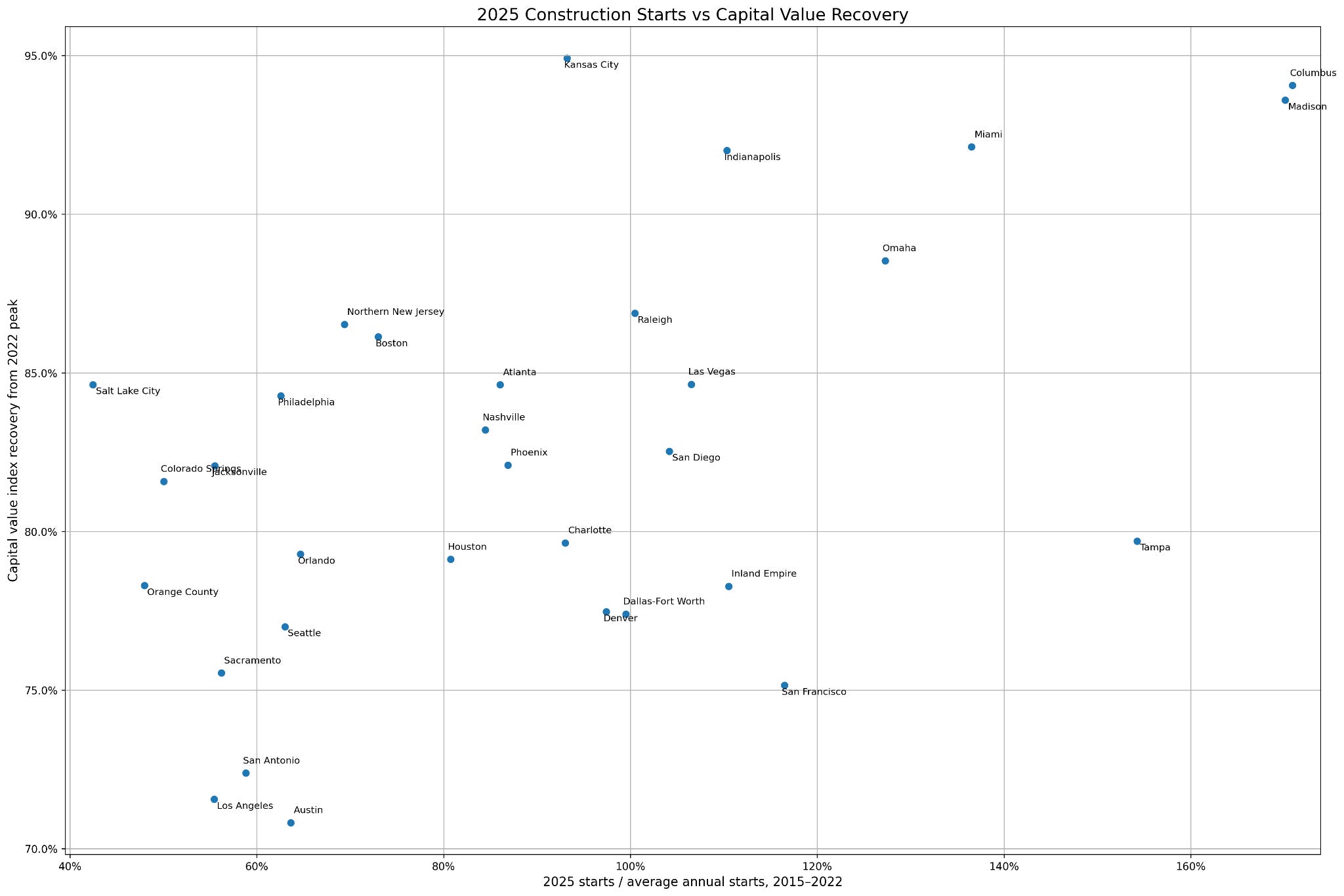
Lastly, let’s plot the level of 2025 starts versus the 2015-2022 average against the percent recovery of asset values. A clear upward trend emerges. Markets with the greatest recovery in asset values had the strongest recovery in starts.
Conclusion
Financial conditions in housing are much more than interest rates on debt. They include the cost and availability of debt, but also equity hurdle rates, exit cap rates, expected rent growth, and investor appetite. Once finance is understood this way, AEI’s own evidence points less toward a refutation of our argument than toward a broader version of it.
The fact that construction did not decline uniformly across metros after 2022 does not show that finance was unimportant. Rather, it shows how financing constraints operate through local market conditions. Markets with strong rent growth were better able to support new starts. Markets with weaker rent growth or deteriorating project economics saw sharper pullbacks. That is not evidence against finance as a bottleneck; it is evidence that finance is mediated through local feasibility.
Nor is this inconsistent with the importance of zoning reform, permitting reform, or efforts to reduce construction costs. Those policies can and should expand the set of projects that pencil. But a project does not get built simply because it is legal to build. It gets built when expected revenues, costs, timelines, debt terms, equity requirements, and exit valuations produce an acceptable risk-adjusted return. In many markets, especially after 2022, that condition has not held.
The lesson is not that zoning and regulation do not matter. They do. The lesson is that legalization alone is not always sufficient. In a high-cost, high-rate, high-hurdle-rate environment, many projects that are socially valuable may still fail to clear private return thresholds. That is precisely why finance is a meaningful bottleneck in housing production, and why serious housing policy must address both the legal ability to build and the financial conditions under which building actually occurs.